|
|
Click the image for 3/4 (0.85
arcsec/pixel) size wide field display.
|
Instrument |
12.5" RCOS @
~f/9 (2880 mm fl) 0.643 arcsec / pixel. Shown
resampled to ~2.0 arcsec/pixel. |
|
Mount |
Paramount ME |
|
Camera |
SBIG STL-11000 w/
internal filter wheel, AstroDon Filters |
|
Acquisition Data |
4/27/2008 to 5/2/2008
Chino Valley... with CCDAutoPilot3 & CCDSoft |
|
Exposure |
Lum
120 min. (24 x 5 min. bin 1x1)
RGB
180 min. (12 x 5 min. bin 2x2) each |
|
Software |
CCDSoft,
CCDStack, Photoshop CS w/ the Fits Liberator plugin, and Noel
Carboni's actions.
CCDStack to register,
normalize, data reject, combine and sharpen.
PhotoShop for the
color combine. |
|
Comment |
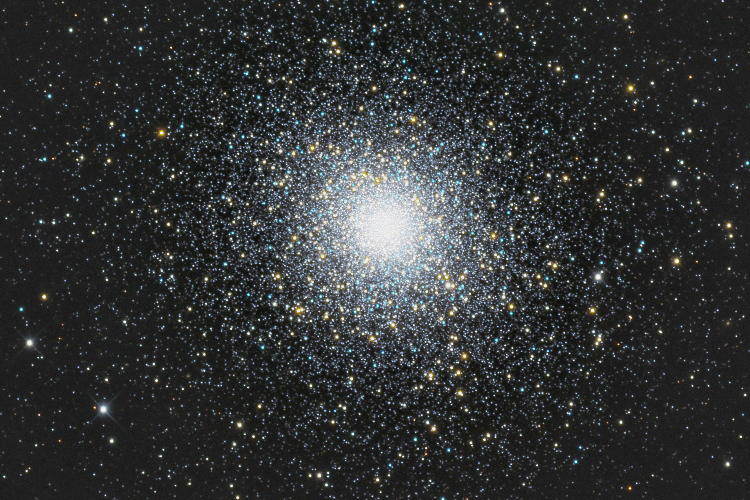
North is to the top.
The globular cluster, M5, contains roughly 100,000 stars. These
stars formed together and are gravitationally bound. Stars orbit the
center of the cluster, and the cluster orbits the center of our
Galaxy. About 160 globular clusters are known to exist in a roughly
spherical halo around the galactic center. Globular clusters do not
appear spherically distributed as viewed from the Earth, and this
fact was a key point in the determining our Sun's location in our
Galaxy. Globular clusters are very old, with M5 being one of the
oldest at a computed age of 13 billion years. Its diameter is about
165 light years, making it one of the larger globular clusters. At
its distance of 24,500 light years this diameter is about 23 minutes
of arc.
Source: NASA APOD & SEDS |
|